Showing posts with label Confederate Impressions. Show all posts

Tuesday, February 23, 2016

The Confederate Historical Trek

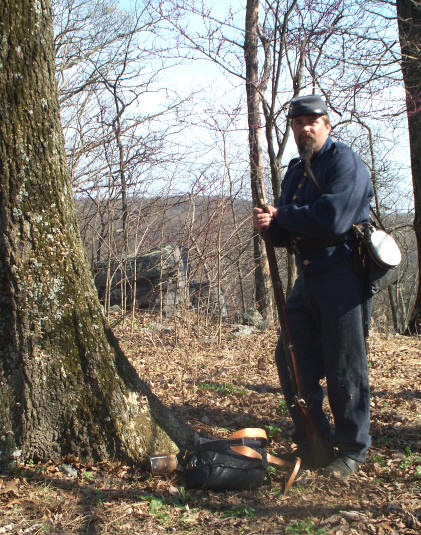
Today, John decided to dress up in his generic 1863 Confederate infantry impression, and go out on a historical trek, following the footsteps of those thousands of Confederate soldiers. The air was crisp at an 32 degrees with some drizzle. Following the road back from Monterey Pass to near Fairfield Gap was nice.  From there, he turned around and sloshed through the roadway. Areas washed out, others very rocky. Even in one section water laid upon it several inches deep. As each area past, he thought of all of those first hand accounts that described how bad the road was when thousands of Confederate marched upon it on July 5-6, 1863. The trek took about a little over one hour to do.

Sunken remains of the old Maria Furnace Road.
As you can see, water is flowing right through the center of the roadbed. 
Here John is along side of Maria Furnace Road. 
You can see the extent of the damage already caused by erosion.
If you look closely to behind John, you'll see the amount of water laying on top of the road. By the end of this week, it'll be flooded out again since they are calling for another round of rain. 
John is now located in the area where living history programs will be conducted along Maria Furnace Road. 

Saturday, March 15, 2014

30th Virginia Infantry Impression at Antietam

It's the start of the 2014 interpretive season and Antietam NPS was the first on the list. I did a generic solider of the 30th Virginia Infantry who fought in the West Woods by the Dunker Church. I talked with the public about the average Confederate soldier and what he carried on during the Maryland Campaign. During the Battle of Antietam, the 30th Virginia Infantry lost more than 68% of its men and the brigade commanded by Colonel Van Manning with the three other regiments lost 77 killed, 387 wounded and 41 missing.

I am wearing the standard Richmond Depot jacket trimmed with black tape on the cuffs, collar and shoulder straps, with Virginia buttons. The kepi and trousers are of the Richmond Depot pattern.


Friday, January 17, 2014

Late 1864 Winter 1865 Confederate Impression

 I have decided to put together a very late war Confederate impression. This impression consists of a full kersey uniform. The kepi is a Richmond Depot, the jacket is the blue trimmed Peter Tait with script "I" buttons and the trousers are patterned from the Richmond Depot.

I am wearing a full set of English accouterments with the exception of the cartridge box. I also wear the painted haversack and carry a tin canteen.

The knapsack is the Isaac Campbell and is packed with my personal belongings. Attached is a boiler which replaces my tin cup and tin plate.

Monday, February 20, 2012

Late War Army of South Western Virginia – Echols’ Brigade

The Army of South Western Virginia was a Confederate army under the command of General John C. Breckinridge in 1864. This army fought at New Market in May of 1864, Cold Harbor and participated in General Jubal Early’s Maryland Campaign. For this impression we have decided to portray the 22nd Virginia Infantry under the command of Colonel George Patton at Winchester where he received his mortal wounding.

These living historians are wearing the Richmond Depot Type III jacket which is made from English kersey. Both living historians are wearing Richmond Depot Trousers made from jeans-cloth. One is wearing a kepi made from jeans-cloth while the other is wearing a kepi made from kersey. Both are wearing cotton shirts, underdrawers and cotton sock. The interpreter on the left is wearing the standard Jefferson Bootie while the one of the right wears the civilian work boot.

The equipment that both carry is somewhat different. The one on the left chooses to wear the blanket roll with all of his personal items wrapped up while the one on the right wears the English knapsack with his blanket, ground cloth and personal items stored inside. Both carry their cartridges in a Richmond Depot issued box and both carry a cap pouch. The interpreter on the right wears a civilian style leather belt with a roller buckle while the one on the right is wearing a British trouser belt. Both carry a British Enfield musket. Both carry a painted haversack containing their rations. The one of the left is carrying a Federal canteen while the one on the right is carrying a canteen made from tin.

Friday, February 17, 2012

Example of a Confederate Mid-war Impression

Several years ago using artifacts that were found at Monterey Pass, I redid my midwar impression. The majority of General Lee’s infantry marched through Monterey Pass during the Confederate withdrawal from Pennsylvania. Several artifacts were found at the site that was Confederate manufactured. Smallest items from buttons and buckles were taken into consideration when I redeveloped my midwar impression.

I am wearing a Richmond Depot Type II jacket made from cassimere that features the flat or coined brass buttons. Several of these buttons were dug at Monterey Pass along with Block I and a few state seals such as Virginia and Texas. The trousers are also of the Richmond Depot pattern and are made from jeans-cloth. I wear a cotton shirt under the jacket as well as cotton underwear with cotton socks. The kepi is made from Kersey an imported cloth from England. My shoes are a civilian pattern work boot.

To show the spoils of a Confederate soldier in Pennsylvania, I have a coverlet wrapped around me in the form of a blanket roll as well as a double bag knapsack contains food, personal items and spare clothing including a military issue blanket. I have a tin canteen with a leather strap, tin cup and a haversack full of rations taken from the countryside.

My leather equipment consists of a leather belt with a Georgia frame buckle attached. There have been several Confederate buckles found at Monterey Pass and along the retreat route including several CS general services spoon and wreath buckles, a Virginia style CSA square buckle and other Georgia frame, and roller buckles. I carry a British Enfield Rifle with a Richmond Depot manufactured cartridge box and cap pouch.

Monday, February 13, 2012

Example of the North Carolina Impression for the Maryland Campaign

This is one of my North Carolina Maryland Campaign impressions that I do at South Mountain State Battlefield and Antietam National Battlefield. Keep in mind that this uniform would be tattered showing the effects of hard campaigning in Virginia. This is a modified North Carolina State issued sack coat trimmed with black epaulettes that was issued after February of 1862 during the transition to the shell jacket. The cut is a few inches shorter in length and features six NC buttons. In the slashed pocket, you can see a wallet which holds some C-notes and letters. The trousers are also matching to the jacket with a black one inch strip running down the seam. The kepi is also matching. I have a cotton shirt underneath the jacket along with cotton under drawers, and cotton socks. The boots are a civilian work boot.

The equipment that I carry consists of a blanket roll which holds a few personal items including a pair of socks and extra shirt. I carry a tin canteen, painted haversack to carry my rations. I have an 1861 Springfield Musket with matching accouterments consisting of a cartridge box, cap pouch and bayonet with scabbard. Holding the accouterments is a roller buckle attached to belt made from bridle leather.

Sunday, February 5, 2012

The 2nd Virginia Cavalry Impression for the Maryland Campaign

I thought that I would bring out an old impression that hasn’t been used in a while. A few years back, I used to do a cavalry impression at Crampton's Gap. With all the musuem renovations, I stopped using this impression and eventually pulled the tape off the jacket for use in other education programs.

This impression is for the 2nd Virginia Cavalry that fought at Jefferson Pass on the Catoctin Mountain on September 13th, 1862 and then at Crampton’s Gap on South Mountain a day later. The uniforms for a cavalryman during this period were not as different as compared to the infantryman. The commutation system, the depot system as well as state issued uniforms were all being used to issue uniforms to the soldiers in the field. The commutation system during the period was already being phased out in favor of the depot system.

This trooper is wearing a Richmond Depot type II jacket in which yellow tape has been applied to the collar and shoulder epaulettes by the trooper. The Richmond Depot type II was a jacket that was issued without trim and often made from cassimere or satinett. The buttons on this jacket are the basic coin style.

The trousers are the Richmond Depot style made from jeans-cloth and feature bone buttons. The kepi is also a Richmond Depot. The undergarments are made from cotton including the civilian style shirt. The Jefferson bootie is worn over cotton socks.

The equipment for this trooper is for dismounted troopers only as the horse equipment will be covered later in another posting. A (Union) saber belt is worn with a leather holster, cap pouch and carbine cartridge box. The carbine that this trooper supports is the Smith Carbine artillery model. The revolver is a Colt 1860 Army and although dismounted and for interpretive purposes the heavy model 1840 cavalry saber known as the “wrist breaker” hangs from the saber belt.

Wednesday, June 15, 2011

Generic Confederate Soldier Impression

This is our new generic Confederate soldier’s impression. This impression is as generic as one can get in my opinion. The 4 button jacket is made from a very light colored gray jeans-cloth material and features four wooden buttons with a slash pocket. This jacket is in my opinion very under represented among various Civil War re-enactors. With the jacket is a Richmond Depot kepi made from English kersey and Richmond Depot trousers made from tan jeans-cloth material. Included, but not shown is the civilian style shirt made from a heavy cotton material in the yellow checkered pattern.

The accouterments include a bayonet scabbard, a 58 cal. Richmond Depot cartridge box with a cap pouch suspended by a leather belt that uses the “Egg shaped” CS buckle. The canteen is made from tin suspended by a leather strap and a haversack full of rations is placed over the English knapsack that contains spare clothing and ground cloth with a blanket. The rifle is a 58 cal. Springfield.

This impression is great for Army of Northern Virginia as well as some of the units that served out in Tennessee. I've seen photographs of many Confederate soldiers wearing a jacket simular to the one being worn in early war to reading accounts of these jackets in the mid to late war.

Wednesday, March 2, 2011

The Confederate Artillery Impression

Working on the South Mountain Cannon Detachment, I have several different artillery impressions. For the main 1862 impression, you would see artillery uniforms of all shapes and colors, from the basic frock to the standard shell jacket. Some of the uniforms would have red trim such as tape, piping, welting, or even solid cuffs and collar, with a wide range of materials being used. Our gun detachment typically wears mostly shell jackets that may consist of a Commutation jacket, Richmond Depot Type I jacket, or the basic cloth saving jacket known as the standard shell jacket.

So for our programming that we do at South Mountain State Battlefield, Harper’s Ferry National Historic Park, and Antietam National Battlefield our uniform standards reflect the wide range of uniforms that would have been worn by the Confederate soldier. Some of us have a standard Richmond Depot Type I with red trim on the cuffs, collar and shoulder straps made from satinette or cassimere, while others may wear a frock coat. The frock coat features a nine button front and is made from a homespun material, and for the most part, is untrimmed. Another type of jacket that can be worn is a standard six or seven button shell jacket with red trim on the collar and cuffs.

When we do the Labor Day weekend artillery demonstration at Gettysburg National Military Park, our gun detachment adopts the mid war appearance where the Richmond Depot Type II jacket is the primary choice. Our trousers are still patterned after the Richmond Depot, however, kepis that have a colored band featuring the branch of service, are replaced by the common Richmond Depot kepi that is plain. Some members wear a slouch hat in place of the kepi. Materials for our uniforms are still a mixture of jeans-cloth and satinette, however a few of our jackets are made from the British imported material known as kersey.

From time to time, we are asked to assist Monocacy National Battlefield and Belle Grove Plantation on the Cedar Creek Battlefield. We again adopt another uniform standard for 1864. Our uniforms are basically the same with the exception of our jackets. Some of us will replace the Richmond Type II jacket with the Richmond Depot Type III jacket that is made from kersey. At Belle Grove Plantation on the Cedar Creek Battlefield, at least one or two of our members will dust off the Peter Tait jacket and wear that.

Saturday, February 5, 2011

An Example of the Confederate Infantry Soldier From 1861-1865

A Confederate soldier in early 1861 to late 1862 wearing a frock coat with brass buttons. He is also wearing jeans-cloth trousers with a militia style kepi. His accouterments are from England and feature the Enfield Rifled musket. His brogans are a civilian style shoe. He also wears the blanket rolled around his body with personal items, and a gum blanket. He is also wearing a canteen made from tin that was from Harper's Ferry and a haversack that carries his rations.

A Virginia soldier in late 1861 to late 1862 wearing a commutation style jacket with wooden buttons. He is also wearing jeans-cloth trousers with a Virginia militia style kepi. His accouterments are from a Virginia or Western Virginia Arsenal with a 58 caliber Fayetteville Rifle with a sword bayonet. His brogans are a civilian style shoe and his belt and buckle are known as the Georgia Frame belt. He also wears the Federal style knapsack that holds his blanket, personal items, gum blanket and a captured shelter half. He is also wearing a canteen made from tin that was from Harper's Ferry and a painted black haversack that carries his rations.

A Virginia soldier in early 1862 wearing a Richmond Depot (type I) jacket with Virginia state seal buttons. He is also wearing a pair of cotton trousers with a kepi both manufactured at the Richmond Depot. His accouterments are from the Richmond Arsenal with a 58 (577) caliber 1853 Pattern Enfield Rifle with bayonet. His brogans are a military style shoe and his belt and buckle are known as the English Type belt. He also wears the Federal style knapsack that holds his blanket, personal items, gum blanket. He is also wearing a model 1858 smooth side canteen and a painted black haversack that carries his rations, complete with a copper dipper.

A Virginia soldier in 1863 wearing a Richmond Depot (type II) jacket with coin buttons, kepi and Richmond Depot trousers made of Jeans-cloth. His accouterments are from the Richmond Arsenal with a 58 (577) caliber 1853 Pattern Enfield Rifle with bayonet. His brogans are a military style shoe and his belt and buckle are known as the English Type belt. He also wears a signal bag knapsack that holds his blanket, personal items, gum blanket. He is also wearing a model 1858 smooth side canteen and a cotton haversack that carries his rations.

A Virginia soldier in 1864-1865 wearing a Richmond Depot (type III) jacket, kepi and trousers. The jacket and trousers are made from imported English Kersey. His accouterments are from the Richmond Arsenal with a 58 (577) caliber 1853 Pattern Enfield Rifle with bayonet. His brogans are a military style shoe and his belt and buckle are known as the fork and tongue. He also wears the Federal style knapsack that holds his blanket, personal items, gum blanket. He is also wearing a model 1858 smooth side canteen and a cotton haversack that carries his rations, complete with a copper dipper.

A Virginia soldier in 1864-1865 wearing a Peter Tait jacket, Richmond Depot kepi and Richmond Depot trousers. The trousers and kepi are made from imported English Kersey. His accouterments are imported from England with a 58 (577) caliber 1853 Pattern Enfield Rifle with bayonet. His brogans are a military style shoe and his belt and buckle are British military issue. He also has the Isaac & Campbell knapsack that holds his blanket, personal items, gum blanket. He is also wearing a canteen and a painted cotton haversack that carries his rations.

Wednesday, December 8, 2010

The North Carolina Infantry Impression at Monterey Pass

After the Battle of Gettysburg, the Confederate Army was devastated. This was a complete turn around from when they invaded nearly a week and a half before. The majority of the Confederate infantry marched through Monterey Pass during their withdraw from Gettysburg. For us here at the Monterey Pass Battlefield, there is no other impression we like to portray more than that of the average North Carolina soldier, primarily the average soldier from the 53rd North Carolina Infantry. However, since new sources were revealed to me, I now know that there was a North Carolina Battalion that was also engaged at Monterey Pass during the battle that carried over into the wee morning hours of July 5th, 1863.

Michael J. Winey and Thomas M. Arliskas have uncovered a tremendous amount of research regarding the Confederate soldier during the Pennsylvania Campaign. Their books are full of first hand accounts that are footnoted in their respective books. One reason why I like portraying the 53rd North Carolina Infantry is that in Michael Winey’s book, “Confederate Army Uniforms at Gettysburg” there is information on the jacket that was worn by a member of the 53rd North Carolina as well as his forage cap. This soldier’s name is Private Amzi Williamson. We can be certain that his regiment wore a similar jacket and cap that was issued by the state of North Carolina. Private Williamson’s jacket and forage cap can been seen on page 145 of the Time Life set “Echoes of Glory - Arms and Equipment of the Confederacy.” In having original photographs as an example of what this unit would have wore, it helps us to better portray the unit accurately.

There are several other great sources online as well . One site in particular is the North State Rifles, an authentic campaigner organization. Their web site, similar to the CVR blog, walks you through a timeline of the average Confederate soldier from North Carolina with research articles on uniforms that the soldiers of North Carolina would have wore. Between the two sources listed above you now have descriptions and as well as a good visual of the North Carolina solider. The North Carolina impression that we use at Monterey Pass is a very research based impression that I am quite proud of.

During the Pennsylvania Campaign, the North Carolina regiments of Pettigrew’s Brigade were issued new uniforms, while those soldiers of Hoke’s Brigade wore a collection of uniforms that were acquired at Winchester courtesy of Milroy’s Federal garrison retreating from the Winchester area. Many shirts, undergarments and Federal trousers were taken. The North Carolina soldiers from Daniel’s Brigade that the 53rd North Carolina was part of, was from what research shows, wearing their North Carolina issued jackets and uniforms.

Soldiers were often issued what was on hand, on an as needed basis instead of regiments receiving a collection to clothing for all their men. The direct result of this is that not all of the soldiers in the same unit would be wearing identical uniforms. North Carolina also had a depot outlet near the Richmond Depot and it was very successful issuing clothing to not only its own soldiers, but other soldiers from different states as well. With that being said, one cannot rule out the fact that many North Carolina soldiers may have been wearing a collection of clothing articles issued by the Richmond Depot. To add to the appearance from long marches from near Fredericksburg to the Mason-Dixon Line, it can be speculated that their uniforms were showing wear and tear, being exposed to the elements of weather, or deteriorating by the movements of the wearer. So there is a lot to take into consideration while researching the uniform aspects of the North Carolina soldier.

For our uniform standards for the North Carolina soldier, the majority of living historians should be wearing a properly constructed North Carolina shell jacket. There are a few surviving examples out there from the Williamson jacket to the Tucker, and McRea jackets. The jacket is a six button front and in most cases, a four piece body and one piece sleeve. Material should be of satinette, cassimere, or possibly jeans cloth. Buttons can be wooden, generic Federal eagle, flat brass or state seal. Richmond Depot jackets would also be acceptable but only on a small scale. There are in existence, some 4th North Carolina cavalry soldiers whose photographs of the time period show them with Richmond Depot Type II jackets with wooden buttons. Trousers can be of a Richmond or other documented military pattern. Headgear should consist of the forage cap, properly constructed kepi, or slouch hat. Civilian and military issue shirts are acceptable.

As far as equipment, one can wear a variety of styles of belts with brass buckles. Buckles could be of English manufacture, roller style, Georgia frame, fork and tongue, or civilian. Cap and cartridge boxes must be of Confederate manufacture and must match the caliber of your musket. Other equipment should include a blanket roll or knapsack, in addition to Confederate manufactured haversacks and tin canteens. Shoes can be of civilian or military issue.

Resources for the North Carolina Impression:
North State Rifles
Time Life set “Echoes of Glory - Arms and Equipment of the Confederacy”
Confederate Army Uniforms at Gettysburg by Michael Winey
Cadet Grey and Butternut Brown, Notes on Confederate Uniforms by Thomas M. Arliskas

Uniforms of the Civil War by Robin Smith and Ron Field
The 26th North Carolina Research Articles
A Tar Heel Jewish Soldier at Gettysburg
Information on the 1st Battalion North Carolina Sharpshooters - Lee Sherrill

Tuesday, November 30, 2010

Generic Western Theater Impression

Many people are under the impression that the Confederacy was always issued the same uniform, you know the one I am referring to, gray frock with the branch of service color on the pointed cuffs and collar, with a matching kepi and trousers with the branch of service color in a stripe sewn to the outer leg. Although this is what Confederate uniform regulations called for, this is not how the soldier of the Confederacy appeared. In some cases, the above statement came in the form of a very early war appearance. However, many volunteers came dressed in whatever they had.

A good program for the living historian to present to the public is somewhat of a fashion show. I like to use a variety of museum quality reproduction items to show the public the difference between a Richmond Depot vs. the North Carolina shell jackets, or show the main difference in all three patterns of the Richmond Depot jacket, comparing them to the different armies of the Confederacy. This is a good visual tool for people. You can break down so many things with just two jackets, comparing the different materials, patterns, and buttons. You can even go so far as to show the variations of the jackets from year to year, as jackets were modified quite frequently to fit need and availability of materials. A program such as this can run you about 20 minutes depending on how much you decide to show.

A little information about this uniform I am wearing: this is a generic western theater impression. This impression could include the Confederate Army in Kentucky, briefly the Army of Southwestern Virginia or the Army of Tennessee to name a few. This uniform is a good example to show students and adults what was worn in other areas of the Confederacy compared to that of the Army of Northern Virginia. As I mentioned this is a good visual tool for program participants.

The jacket is a Columbus Depot issue. It is made from jeans cloth and features the correct blue cuffs and collar. It features five general service eagle buttons. The kepi is made from a cotton mixture of brown on tan warp and features a brown leather bill with two small copper buttons fastening the chinstrap. The trousers are made from jeans cloth and are of a Deep South manufacture pattern.

The equipment consists of a cotton haversack covered in boiled linseed oil used as a water proofing agent. A canteen made from tin and a coverlet for a blanket. The picture on the left has a leather belt with what is called an “egg” brass buckle with the letters CS inscribed on it. The picture on the right has a leather belt with a silver, rectangular buckle with the CSA imprinted on it. Other acceptable belts to wear with this impression would be one of painted canvas or a roller buckle belt. I have a Baton Rouge Arsenal cartridge box with a cap box. I carry the standard the Enfield rifle imported from England.

Keep in mind that with this program, one of the goals is to break the mindset of "the blue and the gray." It was browns and greens and tans too, something that many participants are shocked to find out.

Friday, November 19, 2010

Lucas' Battalion, 15th South Carolina Heavy Artillery, Co. C

One of the numerous impressions that the Cumberland Valley Rifles have represents the Marylanders that traveled to South Carolina and joined the ranks of the various South Carolina units. This impression is the 15th South Carolina Battalion of Heavy Artillery.

Before the first shots of the Civil War at Charleston, South Carolina were fired into Fort Sumter, several South Carolina recruiting officers made their way through the South, recruiting manpower for the upcoming war. Recruiting men from different states was not an uncommon practice during the Civil War. According to the Confederate Military History by Bradley T. Johnson, in December of 1860, South Carolina had sent a recruiting officer to Baltimore and he was able to recruit more than 500 Maryland men for the southern cause. These men would become part of Lucas' Battalion of South Carolina and Rhett's First South Carolina Artillery. These Maryland men would witness the bombardment of Fort Sumter in the Charleston Harbor in April of 1861.

On June 6th, 1861, Lucas' Battalion became designated as infantry, and was mustered into service at Fort Pickens, located on James Island. In July, Lucas' Battalion was converted from infantry to heavy artillery, with two companies that would garrison a few of the forts surrounding Charleston Harbor. Company C, of which many Marylanders transferred to, was organized on November 15, 1862. Lucas’ Battalion of Heavy Artillery also consisted of Child's Light Artillery, Winder's Light Artillery and Lee's Battery. Two additional companies were assigned to Lucas' Battalion with the designation of Companies D and E.

In June of 1862, three artillery units, the Gist Guard Artillery, Mathewes Artillery and Melcher's Battery were attached to Lucas' Battalion. They served primarily on the islands that surrounded Charleston, including Fort Pemberton, a post located along the banks of the Stono River. Garrison duties would have required the build up of earthworks, drilling by the manual of infantry, and also drilling by the manual of artillery. The average schedule for Lucas' troops might have been something along the lines of infantry drill in the morning, artillery drill in the afternoon, and then finishing up in the evening with more infantry drills.

However, some Marylanders served inside the brick walls of Fort Sumter. How often did the artillery units stationed in the garrisons or forts around Charleston rotate? Using Fort Sumter as an example, Mr. Hatcher the Park Historian at Fort Sumter helped me shed some light on the subject.

"From April 1861 to August 1863, the headquarters of the 1st SC Artillery Regiment and Companies A, B, C, D, E, F, & G were stationed at the fort. The remaining companies were stationed at various installations around the harbor. With the first major bombardment of the fort by the US Army and Navy beginning in August 1863 its role as an artillery installation was almost destroyed. As a result, six companies were transferred to various forts and/or batteries in the area and the HQ moved to Charleston. A quick review of our fort records indicates from September 1863 until its evacuation in February 1865, one artillery company would serve as part of the garrison, with infantry providing the bulk of the troops."

"This same review indicated that the artillery company would spend about one month at Fort Sumter before being replaced by another. After the Confederate evacuation of Morris Island in September 1863, Fort Sumter was the primary target of federal artillery. With the exception of the Confederate installations on Sullivan's Island (Fort Moultrie, Fort Beauregard, and others) the remaining harbor defenses received only limited attention from the Union guns. Therefore, I would assume the commands at those installations did not rotate as often."

In the early part of 1862, Lucas' Battalion was stationed near Cole's Island. Lucas' Battalion of Regulars guarded the entrance of the river since the Confederate high command felt that Cole's Island was the key to Charleston. During the middle part of May, all guns were removed from both islands to Fort Pemberton, higher up the Stono River. Fort Pemberton consisted of 16 guns, and was made of earthen mounds to form earthworks.

In January of 1863, at John's Island, an ambush on Legare's point occurred. Two companies of Lucas' Battalion and some other troops on James Island captured the U.S.S. Isaac P. Smith commanded by Capt. F. S. Conover, and a crew of 11 officers and 105 men. The ambush was complete success. One shot did major damage, tearing the steam drum and forcing the crew to surrender. Thier prize capture was an iron vessel screw steamer of 453 tons, carrying eight 8-inch navy guns, or sixty-four pounder, and a 7-inch thirty-pound Parrott gun. After the fight, a crew was put on board and the vessel towed up the river to Charleston.

By April of 1864, many of the Maryland soldiers serving in South Carolina were transferred to the Maryland Line, serving the rest of their enlistments in Virginia. Also in April, 30 men from Lucas' Battalion were used as laborers working on the ramparts of Battery Pringle. They were enclosing the rear-gorge portion of the battery.

In June of 1864, the 54th Massachusetts Infantry advanced up James Island. According to the Regimental History of the 54th Massachusetts, the layout of the island was wide open with a few spots of rising sand mounds. As the 54th advanced inland, it was noted that Fort Pemberton and Batteries Pringle and Tynes were on the Stono River to their left, and from there Fort Lamar and Secessionville were mutually supporting with detached fieldworks for artillery and infantry regiments filled in the gaps. Skirmishing broke out, and the 54th was ordered to halt and lie down on the ground in order to fire their muskets. Whether Lucas' men managed to get into the action is not known at this time, but it is highly probable.

On June 30th, Lucas' Battalion held an inspection of their garrison at Fort Pemberton. 24 men from Captain Richardson's Company B were formed. The following items were described: Discipline, clothing, accouterments and instruction were all marked good; Small arms were noted as mixed, consisting of 1842 muskets and flintlocks that had been converted to percussion; Guard house, quarters and hospital were in good shape and well arranged; The Battery consisted of two 32 pounder rifled and banded seacoast guns that were positioned at the right and left of the garrison; Two naval smoothbore guns were inspected and reported in good shape along with all the carriages.

By the late winter of 1865, as General Sherman approached South Carolina, many Charleston defenders abandoned the city, joining General Johnston who was trying to stop Sherman's advance during the Carolina Campaign. Lucas' Battalion picked up their muskets and took to their new assignment as infantry. They participated in the Battle of Averasboro, North Carolina in March of 1865, fighting under Colonel Rhett's Brigade in General Taliaforro's Division, a part of General Hardee's Corps. After the Battle of Averasboro, they fought at Bentonville, North Carolina. From there they would march toward Durham Station and surrendered at Greensboro in April of 1865.

The appearance of the average soldier in the beginning of the Civil War of Lucas’ Battalion could have consisted of a tailored frock coat with black trousers or a mixture of civilian clothing. Since Charleston was a port city, in 1862 English imports such as accouterments would have been commonly issued. By 1862, Lucas' Battalion may have been issued items similar to that of Captain George L. Buist's Company of the 2nd South Carolina that remained in Charleston. They were first issued gray woolen frock coats, trousers of the same material, and blue kepis. Later they were issued gray cotton coats and trousers with gray cloth hats. They were also issued very dark brown coats with blue trousers furnished by the government, and gray felt (?) kepis. Another issued jacket was a gray round jacket (Charleston Depot). The shoes, when they could get them, were heavy English brogans, very hard on their feet, but durable.

By 1863, the uniform jacket issued to Lucas' Battalion most likely would have been the Charleston Depot jacket. The Charleston Depot jacket was made from imported English wool kersey and had a cotton osnaburg liner. It featured one piece sleeves, functional, buttoning belt loops. a five button front, and the collar was off center. However, the soldiers could have been issued Richmond Depot type jackets or a North Carolina jacket. Late in the war, the Peter Tait jacket, imported from England would have been issued.

The 1st regimental flag is unknown. It may have been the 1st National Flag, or the Stars and Bars as we now call it, or a South Carolina variation flag. It wasn't until April 20, 1863, when Lucas' Battalion was issued the Charleston variation of the battle flag that was used in the Army of Northern Virginia. According to department regulations, Lucas' battle flag would not have had their battalion name or battle honors written on it. Lucas' battle flag measured 48 inches square and was made entirely of wool bunting, with hand stitched sections. The stars were made from cotton. It would be attached to the pole by a red sleeve. Each company would have also been issued a company guidon. The garnet and black colors of the guidon measured 26 inches by 38 inches. Only the artillery and cavalry were issued guidons. A white cotton letter on the garnet color would have been the company letter, while garnet colored letters were sewn onto the black, which was the abbreviation of the battalion.

For Reference:
Marylanders in the Confederacy – Daniel D. Hartzler
Siege Train, the Journal of a Confederate Artilleryman in the Defense of Charleston – Edward Manigault, Edited by Warren Ripley
Flags of Civil War South Carolina – Glenn Dedmondt
A Survey of Confederate Central Government Quartermaster Issue Jackets - Leslie D. Jensen
Tramp Brigade Uniform Standards - Web Site

The 8th Virginia Infantry Regiment Impression for the Maryland Campaign

The 8th Virginia Infantry Regiment was raised in May of 1861. It participated in the Battle of Manassas and then Ball’s Bluff. By March of 1862, it was ordered to Pickett’s Brigade and participated in the Peninsula Campaign. Fighting in Central Virginia throughout the summer, and by late August, the 8th Virginia Infantry had participated in the Second Battle at Manassas.

By September of 1862, the 8th Virginia Infantry marched into Maryland during the Confederate Invasion of Maryland or what is known as the Maryland Campaign. They engaged at South Mountain on the afternoon of the September 14th. There, on the heights of Turner’s Gap, in an area that is known as Frostown, they fought on the extreme right of General Garnett’s line in a wooded area where boulders dotted the landscape. The Confederates in this area held their ground until night fall when they were ordered to Boonsboro.

The 8th Virginia also participated in the Pennsylvania Campaign of 1863, and by 1864 they took part in the Overland Campaign and the Richmond-Petersburg Campaign. On April 6th, at Sayler’s Creek the majority of the regiment was captured or killed, and the survivors were paroled at Appomattox.

This is just one example of a Virginia soldier at South Mountain, and how he may have appeared. Other jackets and uniforms could have been a frock coat, commutation jacket, perhaps a well worn over-shirt or a Richmond Depot jacket made from a higher concentration of wool material such as satinette or cassimere. Some jackets could have had black or blue, and in some cases red trim in the form of wool tape sewn onto the cuffs, collar and the shoulder epaulettes. Another possibility could be civilian clothing that was purchased from some of the towns and cities that the 8th Virginia marched through. This is my impression of a soldier in the 8th Virginia Infantry and what he would have worn during the Maryland Campaign of 1862.

This enlistee is wearing a Richmond Depot jacket with black tape applied to the cuffs, collar and shoulder epaulettes. The jacket also has nine Virginia state seal buttons. The kepi, manufactured at the Richmond Depot, is a militia style that features a black band. His trousers are also manufactured at Richmond Depot. His belt is of plain leather with a Georgia frame buckle. The rifle is a Mississippi Rifle or better known as a Harper’s Ferry rifled musket in 54 cal. Since it is a 54 cal. rifled musket, there is no bayonet. He carried 40 rounds of ammunition in his cartridge box and carries his percussion caps in his cap box. Rations are contained in his black painted haversack and his canteen is made from tin. His blanket and other small personal items are enclosed in his double bag knapsack.

Thursday, November 18, 2010

The 3rd Alabama Infantry Regiment (Gilmore) Impression Summer of 1862

The 3rd Alabama Infantry was organized in Montgomery, Alabama in April, 1861. By the summer of 1862, it was attached to General Robert Rodes’ Alabama Brigade that consisted of the 3rd, 5th, 6th, 12th, and 26th Alabama regiments and was attached to General Daniel H. Hill’s Division. Prior to the Invasion of Maryland, Hill’s Division was not engaged at Second Manassas, but the 3rd Alabama Infantry was the first to plant the "stars and bars" in Maryland. On September 14th, 1862, Rodes’ Alabamians were engaged in the Battle of South Mountain, taking up a thin defensive line north of Turner’s Gap in an area known as Frostown. Later in the afternoon, the Alabamians engaged General George Meade’s Pennsylvania Division. By September 17th, it was again engaged at Antietam. A year later, in 1863, the 3rd Alabama Infantry participated in the Pennsylvania Campaign and fought at Gettysburg. A year later in July of 1864, Rodes’ Division engaged Union cavalry near Crampton’s Gap and participated in Early’s Raid through Maryland and Washington.

This enlistee is wearing what is known as the Gilmore Jacket. The jacket is named after the wearer John Gilmore, and there is a surviving example that can be seen in the “Echoes of Glory, the Arms and Equipment of the Confederacy.” This jacket is made from tan cotton and features black pointed cuffs, collar and sewn down epaulettes. It has seven Alabama buttons down the front and the jacket tapers outward along the hips. The enlistee is also wearing brown cotton civilian style trousers and has a Richmond Depot kepi. His haversack is made from cotton duck and his canteen is the Federal smoothside issue. He carries his cartridge box, cap box and bayonet scabbard on a Georgia frame belt and buckle. All of his personal belongings are carried in his double bag knapsack.

It is uncertain if this type of uniform made an appearance in Maryland, as the original owner of this jacket was wounded at Malvern Hill, Virginia in July of 1862. It is possible with the lack of engagements that a few jackets like this did make their way into Maryland in 1862. The jacket would have been well worn and almost in rags. Another option would be the Alabama state jacket which at that point of the Civil War, could very well be the Murphee jacket.

Tuesday, November 16, 2010

The 50th Georgia Infantry Impression for the Maryland Campaign

At South Mountain State Battlefield, one of my favorite impressions to portray to the public is that of a Confederate soldier from Company F of the 50th Georgia Infantry. The 50th Georgia Infantry Regiment was organized on March 4, 1862, at Savannah, Georgia. Upon mustering into service they drilled at Camp Davis, and served around the defenses of Savannah, Georgia until July of 1862 when they were ordered to Richmond.

At Richmond, Virginia, the 50th Georgia was attached to General Thomas Drayton’s Brigade and was present at Manassas during the late afternoon hours. As General Lee advanced his army toward Maryland in September of 1862, this would prove to be the bloodiest campaign for the 50th Georgia Infantry Regiment. While defending Fox’s Gap upon South Mountain, General Drayton ordered the 51st and the 50th Georgia Infantry into a sunken road, this decision proved to have a devastatingly deadly consequence. Company F was the last in line and was shot down by Union soldiers from the front, flank and rear, they were in a fire fight that surrounded them on all sides. Out of the 230 rifles that went into battle, the 50th Georgia suffered about sixty percent casualties, as they tried to run out of the sunken lane at Fox’s Gap.

During the Battle of Antietam the 50th Georgia was detached to aide Toomb’s Brigade near the Burnside Brigade. In November, two months after the Maryland Campaign, Drayton’s Brigade was ordered to be broken up and the 50th Georgia was ordered to Semmes’ Brigade of McLaws’ Division. The 50th Georgia participated in Chancellorsville, and Gettysburg. By the fall of 1863, it was engaged at the Siege of Knoxville and returned to Lee’s Army in Virginia where they fought bravely during the Siege of Petersburg, the Battle of Cedar Creek, and the Battle of Sayler's Creek.

A great deal of research went into creating this jacket since there are no known examples that survive. The jacket, from what pictures show in research books, is a basic pattern that consists of a six piece body and two piece sleeve. You'll see several living historians wearing these jackets, but very rarely will you see a reenactor that portrays a Georgia soldier wearing the Georgia jacket, which is a shame because this jacket is very handsome, and a great piece for an early war uniform.

This enlistee is wearing what is interpreted as an early war uniform. His militia style kepi and his jacket are a Georgia issue; his trousers are of the Richmond Depot style. If you notice, the Georgia jacket that this enlistee is wearing is made from jeans cloth and features a black collar, black shoulder epaulets, and black facing on the sleeves, and is decorated with three 1/4 inch Georgia buttons, while the jacket itself features six Georgia State Seal buttons. He supports his accouterments on a leather Georgia frame belt which holds his cartridge box, cap box and bayonet scabbard. To reflect the recent English import, he carries an Enfield rifle. Personal items are carried in his knapsack, rations in his haversack, and he carries a tin canteen.

For references, please consider reading the following books relating to Georgia uniforms:
Cadet Gray and Butternut Brown Notes on Confederate Uniforms– Thomas Arliskas
Supplier to the Confederacy, S. Isaac Campbell and Co. London – David Burt and Craig Barry
Uniforms of the Civil War – Robin Smith and Ron Field
Remembering Georgia's Confederates - Dr. David N. Wiggins

Sunday, November 7, 2010

The 3rd South Carolina Battalion Impression

The 3rd Battalion of South Carolina Infantry was mustered into service at Camp Hampton, near Columbia during the winter of 1861-1862. Comany G was added in February of 1862, completing the battalion. For several months they were stationed at Adams Run, 35 miles south of Charleston. The men saw very limited service on Edisto Island, and by June 14, 1862, the 3rd South Carolina Battalion was ordered to James Island just outside of Charleston.

In July of 1862, the 3rd South Carolina Battalion was ordered to Richmond, Virginia, where it became part of General Thomas Drayton’s Brigade. In late August, during the Battle of Second Manassas, General Drayton’s Brigade was ordered to attack, holding the right of the Confederate Army. However, it became detached from the right of Longstreet's Wing and was too late to assist in the battle, therefore, only seeing limited action.

During the Maryland Campaign, Drayton’s Brigade was at South Mountain during the battle at Fox’s Gap. Drayton, not following his orders again, launched his attack. The end result was more than 70 percent wounded, captured and even killed within a twenty to thirty minute period. At Antietam, Drayton’s Brigade was too low on man power to be effective, and by November 15th, Drayton’s Brigade was disbanded sending those units to other brigades. The 3rd South Carolina Battalion was ordered to Kershaw’s Brigade. They participated in many of the major battles with the Army of Northern Virginia including the Battle of Gettysburg. They transferred with Longstreet to the Army of Tennessee and fought at Chickamauga as well as Knoxville.

The 3rd South Carolina Battalion then transferred back to the Army of Northern Virginia for the 1864 Spring Campaigns and by September they transferred to General Early’s Army of the Valley. By 1865, the 3rd South Carolina Battalion had participated in the Carolina Campaign and was forced to consolidate with the 3rd and 8th South Carolina Volunteer Infantry Regiments, finally surrendering at the Bennett Place in North Carolina.

The 3rd South Carolina Battalion Impression, Maryland Campaign of 1862

This photograph shows what a soldier from the 3rd South Carolina Battalion may have looked like during the Maryland Campaign of 1862. Researching the impression it was determined that since many of the soldiers were stationed near Charleston, South Carolina, they were well equipped with items that managed to slip through the blockade on the South. Such equipment may have consisted of English accoutrements, weapons and other well needed items.

The uniform pictured here shows a Charleston Depot kepi, a well tailored frock coat, and Richmond Depot trousers. He also wears his a cotton shirt and drawers and braces to hold up his trousers. This soldier wears a coverlet which is a civilian style blanket, English belt, cap box, English cartridge box and a well worn Confederate haversack. His gun is a British Enfield Rifle complete with a bayonet, scabbard and frog.


For references, please consider reading the following books relating to South Carolina uniforms:
Uniforms of the Civil War – Robin Smith and Ron Field
Tramp Brigade Uniform Standards - Web Site